
Abu Ishāq Ibrāhim bin Muhammad al-Farsī al-Istakhrī known as al-Istakhrī, ﻯﺮﺧﻄﺼﻻﺍ ﻰﺴﺭﺎﻔﻟﺍ ﺪﻣﺤﻣ ﻥﺒ ﻡﻳﻫﺍﺭﺒﺍ ﻕﺣﺴﺍ ﻮﺑﺍ (died 957 CE) was one of the most prominent Persian (known as IslamIc) geographers. Al-Istakhrī is known primarily for his book of geography entitled Kitab al-Masālikva al-Mamālik ﮎﻠﺎﻣﻣﻠﺍ ﻮ ﮎﻠﺎﺴﻣﻠﺍ ﺐﺎﺗﮐ (Book of Routes and Realms), various versions of which contain 19 to 21 maps, including a world map and maps of the Muslim lands, together with chapters of related text providing descriptive information about each map, province and people living in them. In all the versions there is a chapter on “Armenia, Arān and Azerbaijān”, where the relative positions of these three lands, names of their cities are listed. Thirty-four of al-Istakhrī’s manuscript copies have survived, most of them with many maps of which the oldest dates from 1173 CE.i
The attached imageis one of al-Istakhrī’s map entitled Surat Armīniya va Arrān va Adherbeijān taken from yet a copy of his manuscript of Kitāb-ul-Masālik va al-Mamālik ﮎﻠﺎﻣﻣﻠﺍﻮ ﮎﻠﺎﺴﻣﻠﺍ ﺐﺎﺗﮐ, the original of which was written in 950 CE. This copy is kept in the Museum of Iran Bastan in Tehran and is a Persian translation of the Arabic manuscript, dating from 1325 CE. Contrary to other maps of his book, where the maps have south at the top, this map is oriented with north at the top.
In this map the cities are coloured in a variety of colours and the city of Nashwi (Nakhijevan) is shown at the foot of the Small Ararat, where Dabīl used to be, and Dabīl has been elevated to near the summit of Small Ararat, here named Māsst (in Armenian – Māssis). Here the differences created by the copier of the map are very clear. The scribe may have used a previous map as a source, but has also used his imagination in presentation of various features of the map. The error in naming Ararat as Māsst instead of Māssis, is due to the scribe’s unfamiliarity with the name. The misplacement of the dots in the Arabic and Persian scripts has changed the letter from “is” to “t”, thus renaming this mountain.
Someone has later corrected the course of the river Arax to join the Kura prior to reaching the Caspian, whereas in other old maps these two rivers are shown each flowing into the Caspian separately. The correction has been made subsequent to the completion of the map and is drawn in different ink.
On the western shores of the Caspian we see Bāb-ul-Abwāb (Derbend, orange), Shābarān (red), Bāku (green), with Shirwān(grey), Shamākhi (orange) and Shaki (red) to the north of the river Kura. To the south of it we note Tiflis (orange),Qal’ah (green), Khūnān (red), Shamkur (green), Jenzeh (orange, misspelled in the map), Bardahe (Barda – red) and Bylghān (green), all shown in the territory of Arrān (Caucasian Albania). The river Arax runds along the southern border of Arran, between Arrān and Adharbeijān.
Further south, in the territory of Azerbaijan, south of Deilam Mountains (the Alborz range) there is another river flowing through Gilān (or Tabarestān) province of Iran into the Caspian Sea. Its name is given as Sefid Rūd, White River.
To the South of the river Aras (or Arax), at the western edge of the map we note the city of Kāliklā (in yellow, the old Armenian city of Karin, now Erzurum) and Malāzgerd (red). Next to Malāzgerd are the twin mountain peaks of Ararat (see paragraph two above). To the east of these lies the Armenian city of Nakhijevān, here named Nashvi (yellow). Between the twin peaks of the Ararat, the old Armenian capital Dabīl (Dvin – red) is also shown. The road leading from Ardebil south-westward is lined with the cities of Khunj (orange), Marāghe (green), Dākherghān (red), Urmiya (green), Salmās (orange) and Khoy (green). The road then carries on to the territory of Armenia and passes through Berkrī (red), Arjesh (green),Khlāt (orange), Bitlīs (grey), Miāfārghinii (green) and Āmad[iaiii (red). The city of Arzan (red, just below Ararat) is located near the end of this road. This province is indicated with the inverted and slanting legend Bilād Armīniya (Armenia). The large circular lake, half of which is shown on the map, is entitled Daryāye Armīniya, the Armenian Sea (Lake Van).
The large mountain in the centre of the map located in the province of Azerbaijan is Kuh-e-Sabalān (Mount Sabalān). On the road emanating from southeast of this mountain, from the right we see the cities of Ardabīl (green circle) on the crossroads, Miāneh (red semicircle), Sarāb (grey), Eram (orange), Ahar (grey) and Marand (green). Other cities of Azerbaijan shown on the road going south-east from Ardabil include Meymand (grey) and Zanjan (orange), with the cities of Dājermān (green), Tabriz (red), Ashneh (Oshnaviyeh – green) and Dināwar (yellow) shown away from the main road. The city of Shahrazūr (orange) is outside the map frame, on the border of Aljazeerah (Mesopotamia).
Once again here we see the roads interconnecting the main cities of the region, making this a regional road map.
The map clearly indicates that the countries of Aran (Caucasian Albania) and Azerbaijan are two distinct and separate lands separated by the river Arax, while the text specifies the difference of the ethnicity and language of their population. It also is clear that on the northern banks of the River Aras (Aras) there is not country entitled Azerbaijan.
©Rouben Galichian
2011
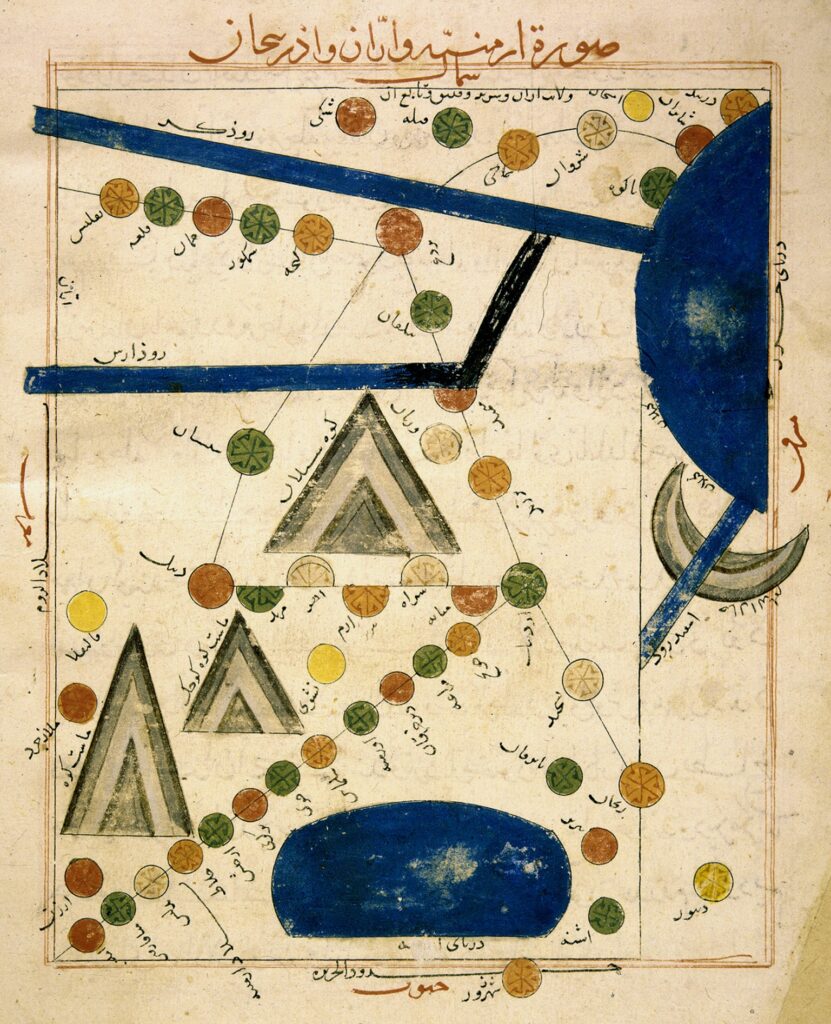
Istakhri’s map entitled The Map of Armenian, Aran and Azerbaijan, from his book entitled Kitab ul-Mamālikva al-Masālik. MS dating from the 950 CE.
Iran Bastan Museum, Tehran.Ref. MS.3515, f. 75b.Copy dated 1325 CE.
i Harley and Woodward, History of Cartography, Vol. 2, Chicago: CUP, 1992, p.130.
ii The old city of Tigranakert (near Silvan), which was one of the capitals of Armenia, built by King Tigran the Second, during 70’s BCE. See Hacopian., Melik-Bakhshian et al. Toponyms of Armenia and the Neighbouring Countries, Vol. 1, Yerevan, 1991, 678, 818, Vol. 5, Yerevan, 2001, p.92.
iii Amadia (in Armenian- Amid) was a castellated Armenian town today situated in the territory of Eastern Turkey.